

SAMUEL HARVEY V.C.
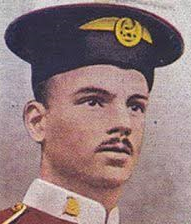
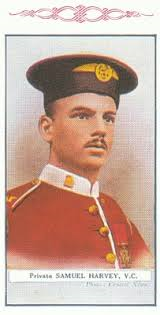
PRIVATE SAMUEL HARVEY V.C.
K e i t h S t a f f o r d
 “Firty-free”… Raeburn Road, Ipswich, Suffolk – A council house on a large council estate called Gainsborough. This is where the Sam Harvey story starts, a few years after his death.
I was born to older parents, each from whom I inherited a Brother, Peter – from my Father, Albert Harry and a Sister, Maureen – from my Mother, Gladys May (both more than 20 years my senior from previous marriages). As a result, I was raised as an only child. Playtime was mainly spent finding things to do to entertain myself.
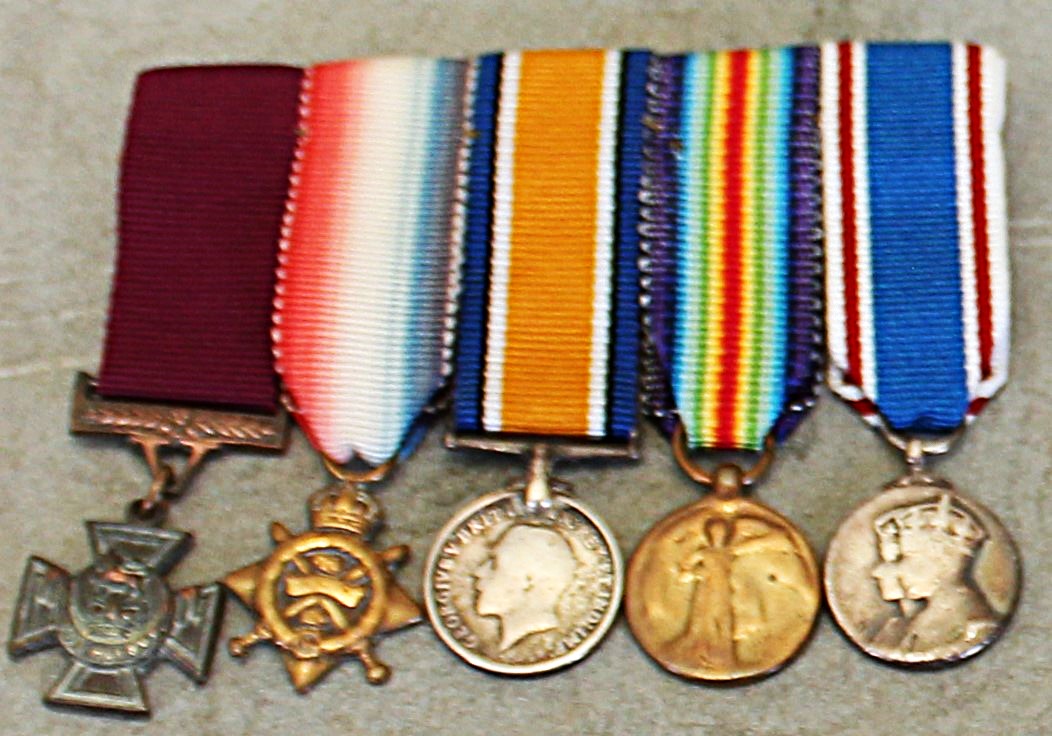 One of the pastimes was playing with some of the contents kept within a burgundy and cream Marconi Radio, not working but still in a case with a lid on, being used to store old buttons, cottons, coins and five miniature medals won by an Uncle named Sam. I just played with them like toys prior to them being a final addition to a ‘guy’ made one November, which my Dad set fire to at night while letting off a few standard fireworks (why the medals never went up in flames that night was due to my mother discreetly removing them…. I later learned).
I attended Orwell Junior School and was in Mr Kendall’s class. Not the smartest of students, just about grasping the three ‘Rs’ – Reading, Riting and Rithmetic. Most Suffolk folk back then used a lazy accent compared with other parts of the country. A sentence, such as “ I have to do my Arithmetic” was spoken as “gotta do me Riff-matic.” That’s exactly how I wrote it, not helped in any way with my punctuation or spelling, which was, is and always will be ‘atRotiuOs’.
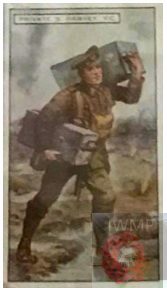 One particular lesson was to create an Interest Folder, already causing a problem for a kid who had no interests…. For the rest of the class, it was dinosaurs or footballers for the boys and pop singers for the girls. My choice of Interest Folder was based on Private Samuel Harvey V.C. a.k.a. Uncle Sam.
Mr Kendall seemed to be the only one interested, although classmates did get to wear the miniature medals when I took them to school – again, how they didn’t get lost, stolen or swapped is beyond me! This, with the aid of a basic description from my Mum of an Uncle who loved mint humbugs and cream cakes, went to war, was very brave and got a medal… even though he got shot in the head!
Sometimes, whilst playing on my own, I got to be a soldier, at times being fatally wounded and falling on my back in a star shape, every time I got killed firing an imaginary machine gun that went rat-a-tat-tat. My hand grenades were lumps of earth that I could throw and would only explode when they hit something hard, usually the garden path. That’s when my Commanding Officer would shout from the kitchen, “Keith…stop’at ya little monkey …I’ve gotta come clear ‘at’ up now,” in one of those Suffolk accents… my battle was over, resulting in me running for cover in tears.
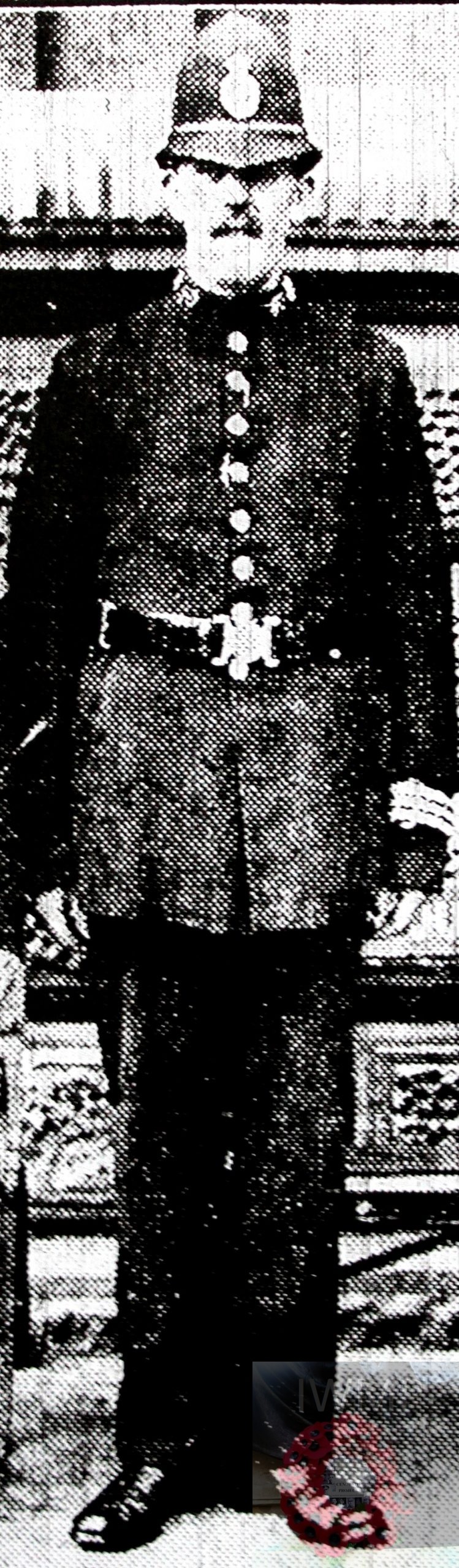 Samuel Harvey was born in Nottingham in 1881. He was raised by his Mother and Father – William and Mary Harvey, along with his eight siblings, Emily, Rose, William, Haylyn, Frederick, George, Hennery and Ellen. Uncle Sam had a twin sister, who, it is said, gave him the nickname Monkey because of his sense of humour and practical jokes. Leaving Nottingham in 1884 when he was aged three, the family moved to 8 Vernon Street, Ipswich in Suffolk, the county his parents had left in search of employment.
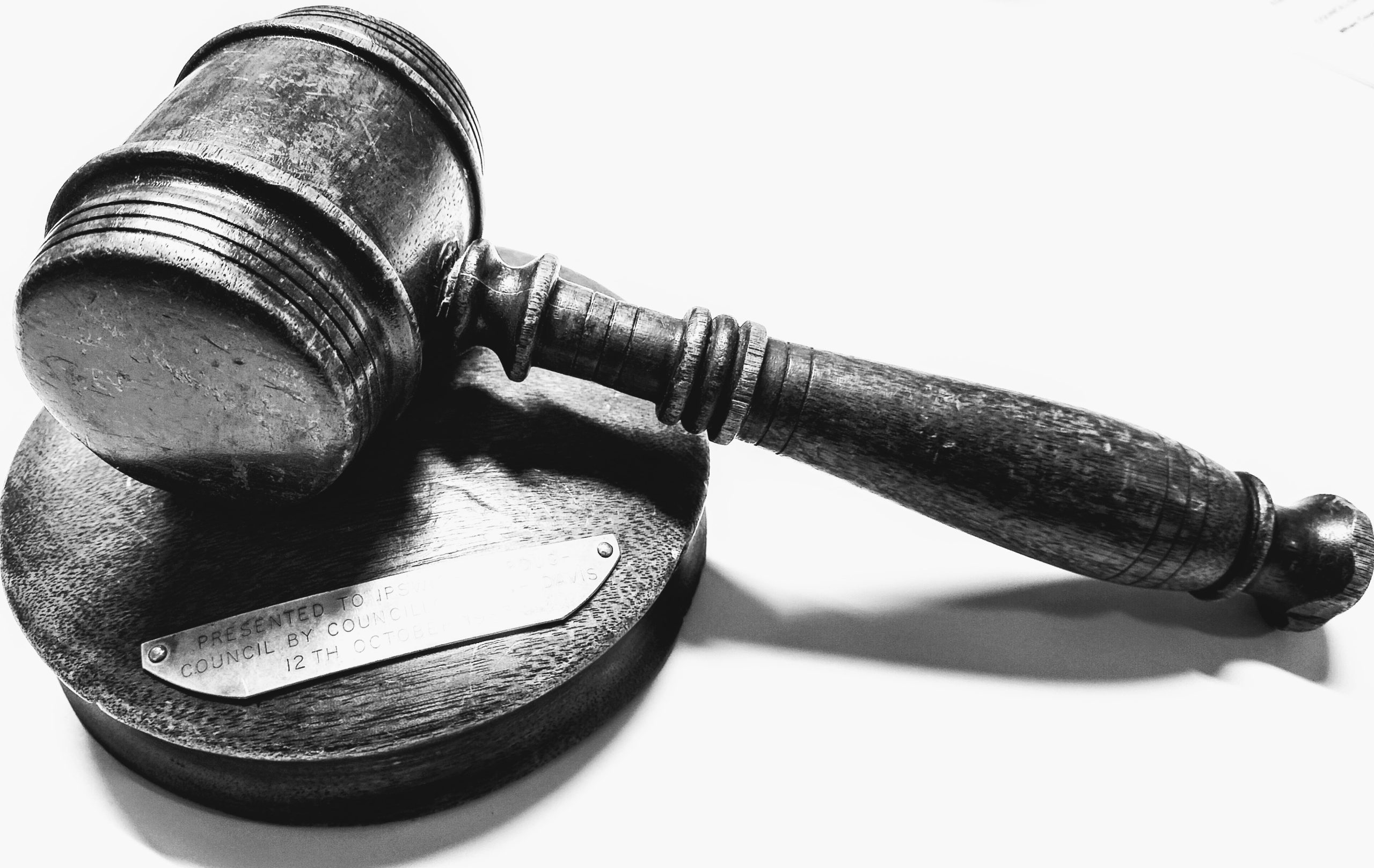 Ipswich was where Sam grew up from a boy through to a teenager, where he was often in trouble with the local constabulary for stealing cigarettes. He later went onto making two other court appearances, the last of which resulted in him being sent to the Warwick Reformatory until he reached the age of 19. Upon release, he found work at a farm in Warwickshire. In 1903, when in his early 20s, he signed up and joined the Army Service Corps, finding himself again in trouble on two more occasions, resulting in him being placed in civil custody.
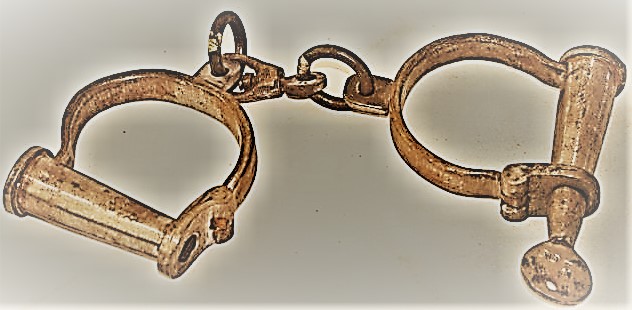
In 1904, he was kicked out of the Army on a misconduct charge before returning to civilian life. Again, Sam found himself in trouble with the Law which resulted in two more offences – the first for disturbing the peace (with the punishment being an eight shilling fine or 7 days imprisonment). The second charge was for being disorderly and refusing to quit (carrying the punishment of 14 days’ hard labour or a fine of one pound four and tuppence).
We pick up his story again in 1905 when, after re-joining the Army with the Suffolk Regiment and soon after being transferred to the 1st Battalion York and Lancaster Regiment as 8273 Private Samuel Harvey. He then served seven years in India before coming out to the reserve. In 1914, six weeks before the outbreak of WW1, he was recalled. Aged 34, he found himself fighting for his country in the Battle of Loos. The British had retaken an old German trench they named Big Willie.
It is recorded that within the first ten minutes of action, there were already 3,583 casualties of the battle, rising to a number of 61,000 in the coming weeks, of which there were 7,766 deaths. Preparations were made for what is now referred to as the Big Push.

 The battle saw four days of artillery bombardment, combined with violent thunderstorms and chlorine gas. The British were using the gas for the first time; however, a change in wind direction caused the gas to blow back in their faces, which, in turn, resulted in casualties from both sides. Private Sam Harvey was what was known as a runner. His job was to convey messages from the Army HQ to the battle being fought on the Western Front. Additional research suggests that it was, in fact, the Army where he acquired the nickname of Monkey (standing at five feet, slight in statue and also being agile and fast), which questions the earlier suggestion as having been given to him by his twin sister.
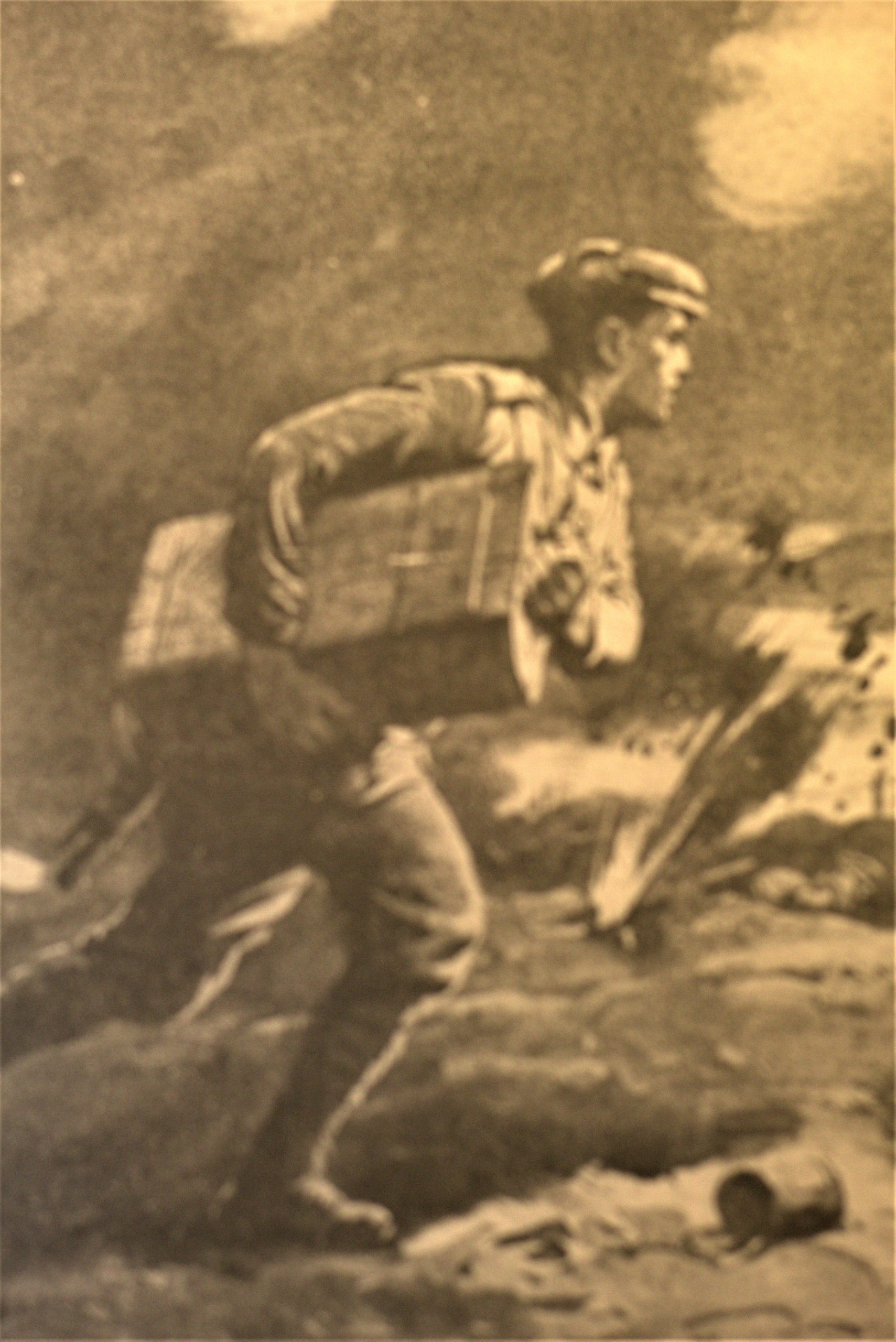 Low on ammunition and with supply dumps a long distance away, a Commanding Officer asked for a volunteer to fetch more grenades – known then as Mills bombs (very similar to the lumps of topsoil I used to throw in my garden…but heavier and able to make a much bigger bang). Private Samuel Harvey was the man who volunteered and made his way through the trenches littered by fellow soldiers, albeit the dead or wounded, and not aided by the reinforcements running through the same trenches who had been sent to boost the British numbers. His mission was to collect large and bulky wooden boxes, each holding 30 Mills’ Bombs, to bring to the battle front.
It became evident this was becoming a long and slow route, and he (and he alone) made the decision to run in open ground and, with no clear landmarks, exposing himself to extreme danger on every run. After more than 13 hours of continuous running and carrying 30 boxes, a total of 360 grenades were delivered safely. Sadly, whilst carrying the last box of grenades yards from the British trenches and in sight of his battalion, his luck ran out. Sam took a bullet to the head and dropped to the ground (drawings of the action depict Sam not wearing a tin hat but instead a soft material Army cap). A helmet may have stopped the bullet from penetrating his skull – or at least deflected the impact.
With grenades again running low and still under heavy fire, a Commanding Officer asked for another volunteer to retrieve the box of grenades lying beside Sam Harvey’s motionless body. Under fire, a soldier recovered the last box of Mills Bombs and returned to the trench, saying Private Harvey was still breathing.
The decision was made to wait until under the cover of darkness before more men risked their lives in the recovery of his body.
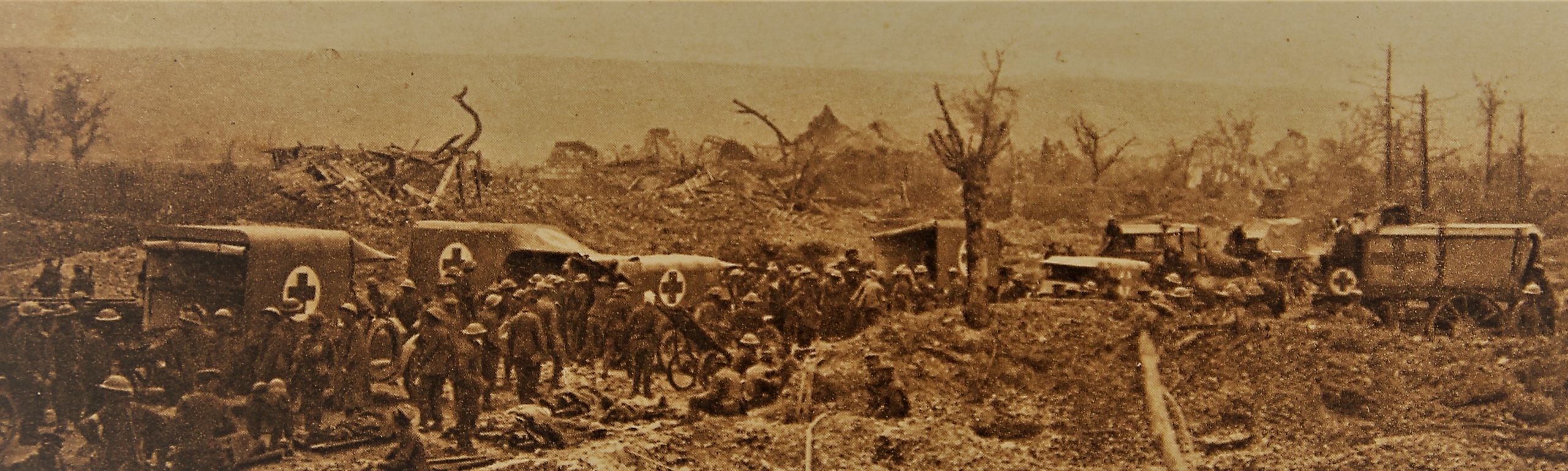
Private Samuel Harvey lived but was never able to have the German bullet removed from his skull as it had settled too close to his brain. If he had not taken the risks he did, his unit would have been cut off and overrun, resulting in a large section of ground being retaken by the enemy, thus changing the course of the battle.
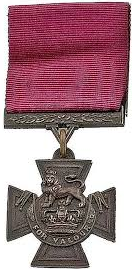
On 29th September 1915, Private Samuel Harvey was awarded the Victoria Cross. On 17th January 1917, it was presented to him by King George V, the very King from the same country he was fighting for. Private Samuel Harvey was to contest more battles in WW1 and was wounded a further three more times before receiving an honourable discharge on 15th May 1918.
Returning to Ipswich as a civilian, he was to carry a slight limp from injuries sustained for the rest of his life.
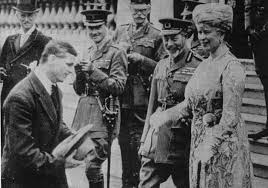
Buckingham Palace, 26th June 1920.(Victoria Cross Garden Party)
Although Sam was known to be a bit of a lad it seems he was uncomfortable being in the spotlight or being recognised as being a hero, so much so that not really knowing how to accept the medal as the Monarch pinned it to his chest – he turned towards the Queen standing at the King’s side, winked, grinned broadly and in a loud voice said….
“MINE’S A PINT!”
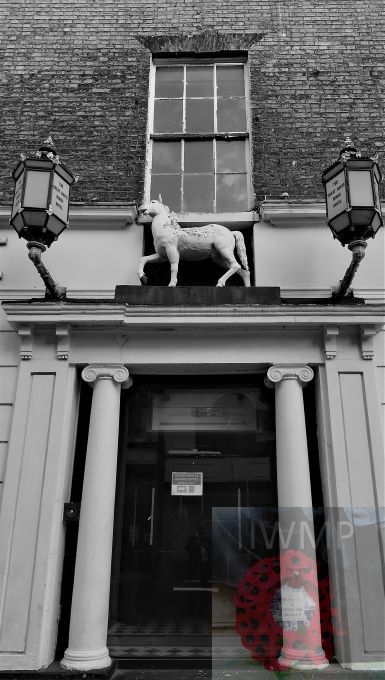 Sam Harvey’s life was far from an easy one. After the war, he struggled to find work. He scratched a living as an Ostler at the Great White Horse Hotel in Ipswich (made famous by Charles Dickens’ classic ‘The Pickwick Papers’), amongst other jobs, such as an odd-job man and gardener. One Ipswich resident recalled seeing Sam digging in a garden muttering repeatedly, “Dig that trench …dig that trench.”
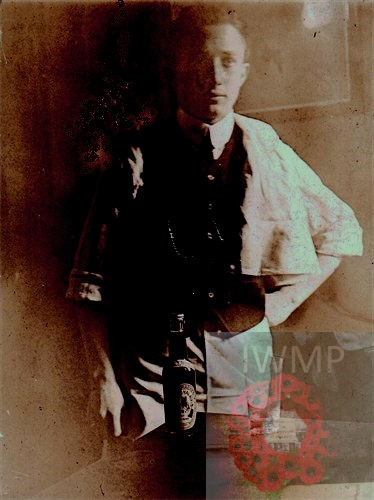 With very little money in his pocket, he became a victim of the bottle, spending most of his time reciting his memories to anybody interested…….for the price of a pint. In the 1930s, he lived in a hut in Wolves Wood just outside Ipswich.
During the 1940s, at 64 years of age, he married and moved to 10 Adelphi Place in Ipswich. His wife, Georgina (also a heavy drinker), died from diabetes five years later. The 1950s saw Sam regularly sleeping rough outside on the Town Hall steps and also residing at a Salvation Army Hostel before moving to an old people’s home.
In 1953, he was to attend, alongside my Mother, a Centenary Party at Hyde Park, London, hosted by Queen Elizabeth II.
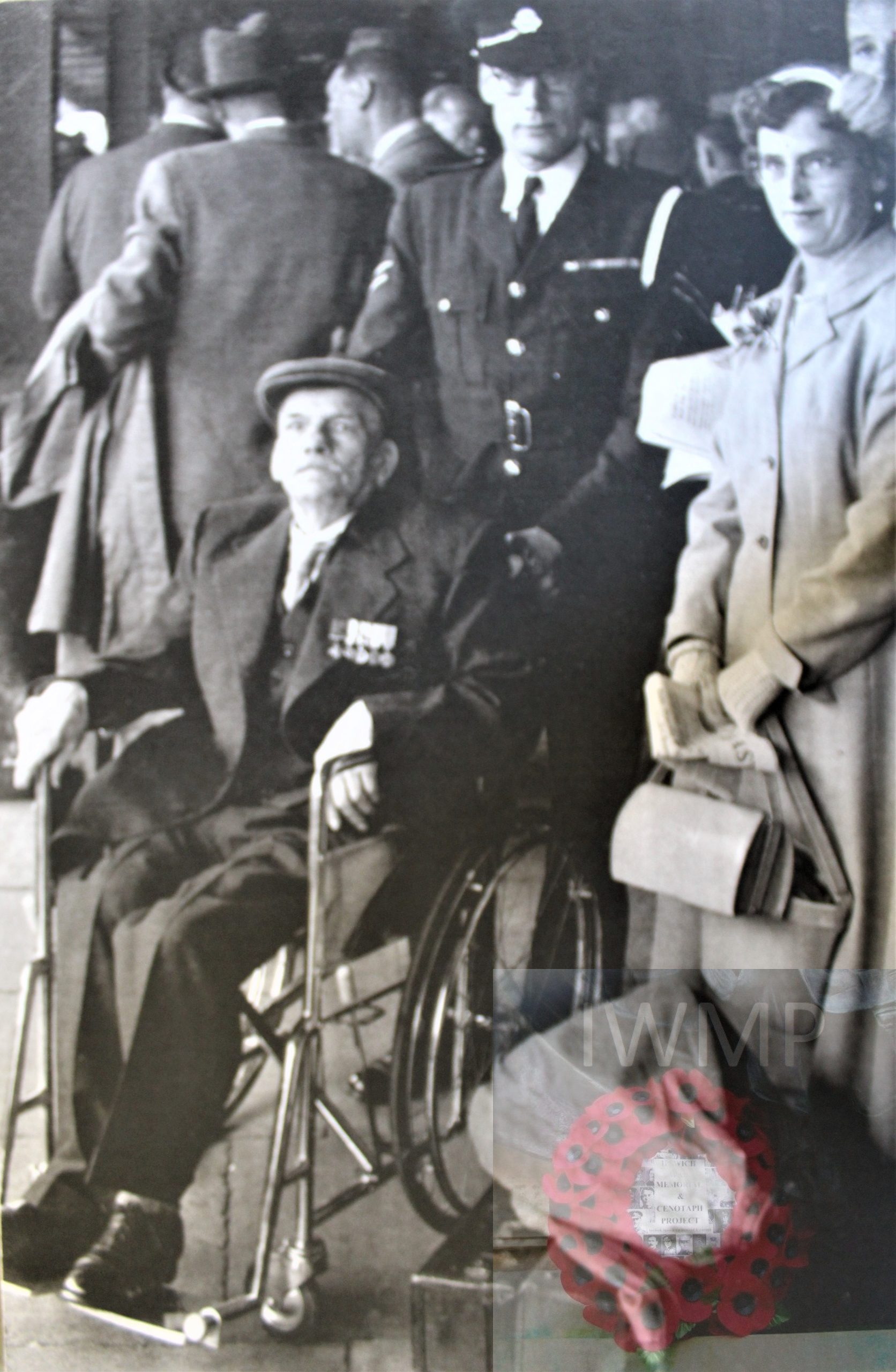
My Mother with Uncle Sam and the Miniatures
Later in life, he was badly injured by a falling gutter, and at 78 years of age, after a bad fall, the legs that carried the heavy boxes of grenades for more than 13 hours in WW1 were unable to bear his weight any longer.
In 1960, aged 79, he died penniless in a hospital in Stowmarket; his only possessions were the miniature medals found under his pillow. He was later laid to rest in a pauper’s grave, with the burial said to have been attended by approximately 200 people. Sam died, always saying he didn’t remember how the original V.C. medal had become missing.
Several theories surrounding the mystery are that he simply lost it while returning to his hut in the woods drunk one night. Another is that he may have been robbed when sleeping rough.
The most famous of them is that he swapped the original Victoria Cross medal with a barman for a pint of beer, which is probably a more likely scenario. Sam had already, on one occasion, attempted to trade it in for cash but this was fortunately averted by the local constabulary who had had a whip round for him in order that he could attend a function in London smartly dressed in a new suit.
That same constabulary later received a phone call on Sam’s return journey, from the owner of a Pawn Shop, saying Sam was attempting to sell his original V.C. war medal………. and one brand new suit!
Two stories have remained unanswered. The first, alongside the miniature V.C., there were four other service medals he’d been awarded, each of which would have had a bigger brother or sister. In total, Sam Harvey was awarded eight medals in his lifetime, and nobody ever spoke of those other seven original medals, all of which today are unaccounted for.
At nine years old, I was too young to even think to ask the question that can no longer be asked, as my Sister is the last surviving relative to have met him. She, as a teenager alongside my Mother, had not only pushed him to a pub in a wheelchair close to the Salvation Army Hostel, but also taken him his favourite cream cakes at the hospital in Stowmarket towards the end of his life.
The second question being every time Sam’s name was mentioned by my Mother along with the lost V.C., it was always said that when joining the Army, he lied about his age in order to make him old enough to be allowed to sign up. However, only when researching for this manuscript did I realise the dates didn’t add up.
Sam was in his 20s when he first enlisted. This also raises another question. In days when people were referred to as Mr, Mrs, Miss or Master……. Smith or Jones, etc., if there was ever any skulduggery or misdemeanour in that family’s history? The Mr, Mrs, Miss or Master title was dropped, leaving the whole family to carry a black mark against them for life, thus being referred to as the Smiths or the Jones…… was this the case of the Harvey family as a result of Sam’s years spent in the reformatory…?
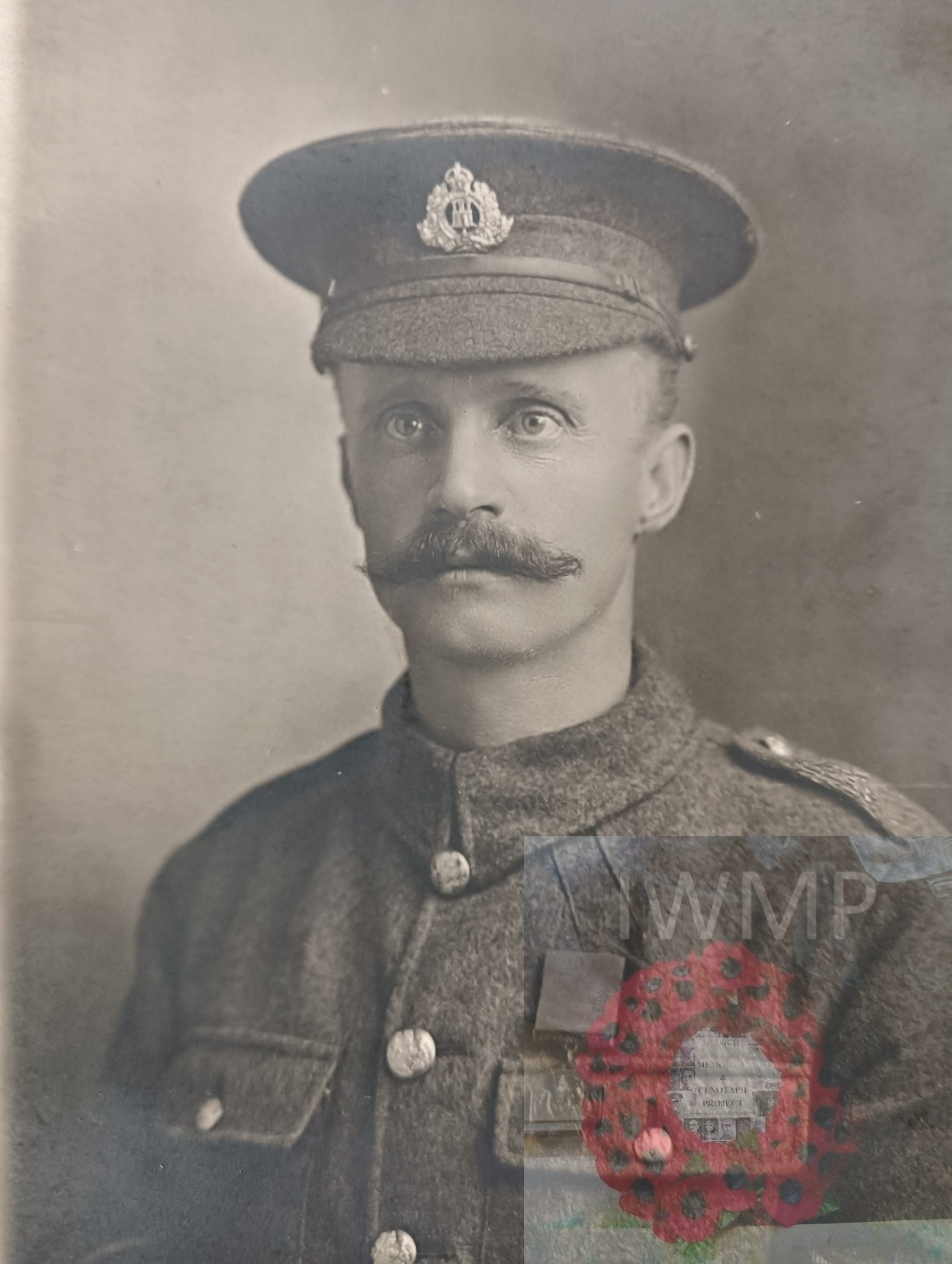
Sergeant Arthur Saunders V.C.
Sergeant Arthur Saunders was born in Ipswich in 1879 and grew up to have a stint in the Royal Marines before working at Ransomes, Sims and Jefferies. The outbreak of World War I also saw him at 36 years old in the thick of it at the Battle of Loos, the same battle Sam fought so gallantly.
After his Commanding Officer had been wounded in an attack, Arthur took charge of two machine guns and a few men and even after being seriously wounded in the thigh, gave support to four more charges by another Battalion that eventually, under heavy fire, was forced to retire.
Carrying a leg wound and in immense pain, down to just one machine gun, he continued to fire at the enemy, whilst giving clear orders to his men. His continuous firing was vital in order to cover the retirement of the retreating British soldiers. Bleeding heavily, Arthur Saunders was later recovered by stretcher-bearers, where eyewitnesses described his leg as hanging on by a thread. Common belief at the time states his leg had to be amputated; however, this is now known to be inaccurate, with the result being that after intensive surgery, his leg was to become three inches shorter, resulting in Arthur wearing a medical boot to aid his walking.
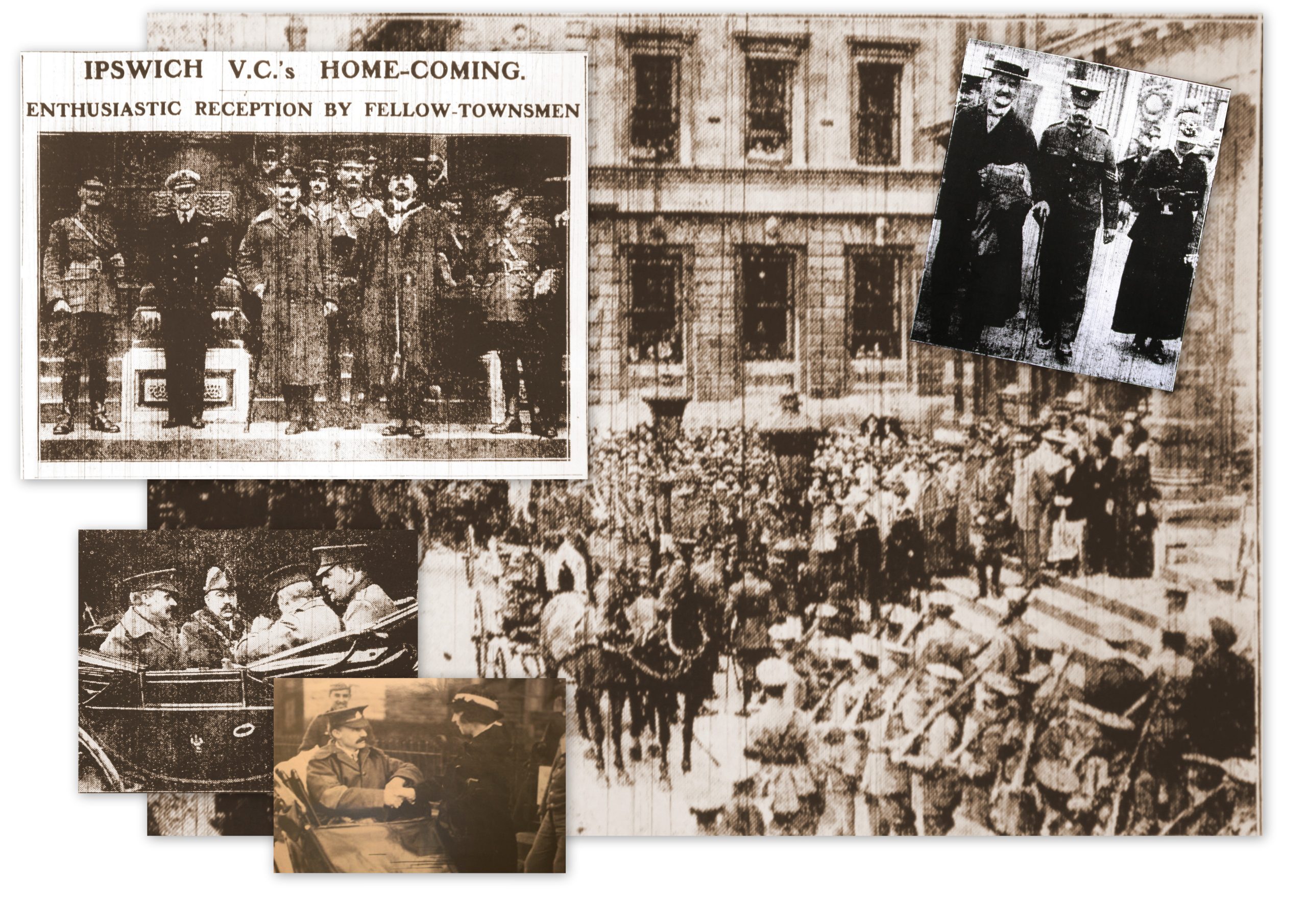
Sergeant Saunders was to spend many months in hospital before being released and returning to Ipswich with the aid of a wheelchair, where he was greeted with a rapturous welcome. He was driven by an open carriage – past the adoring, cheering, flag-waving public lining the streets – to a packed Cornhill in front of the Town Hall steps.
He was given a cheque by the Mayor for £365 (proceeds from which he bought a new house in the town) at the Civic Reception held in his honour. When leaving the reception and returning to 180 Cauldwell Hall Road, the house where he was born (now displaying a blue plaque to honour him), he was accompanied by a drum band from the Royal Fusiliers.
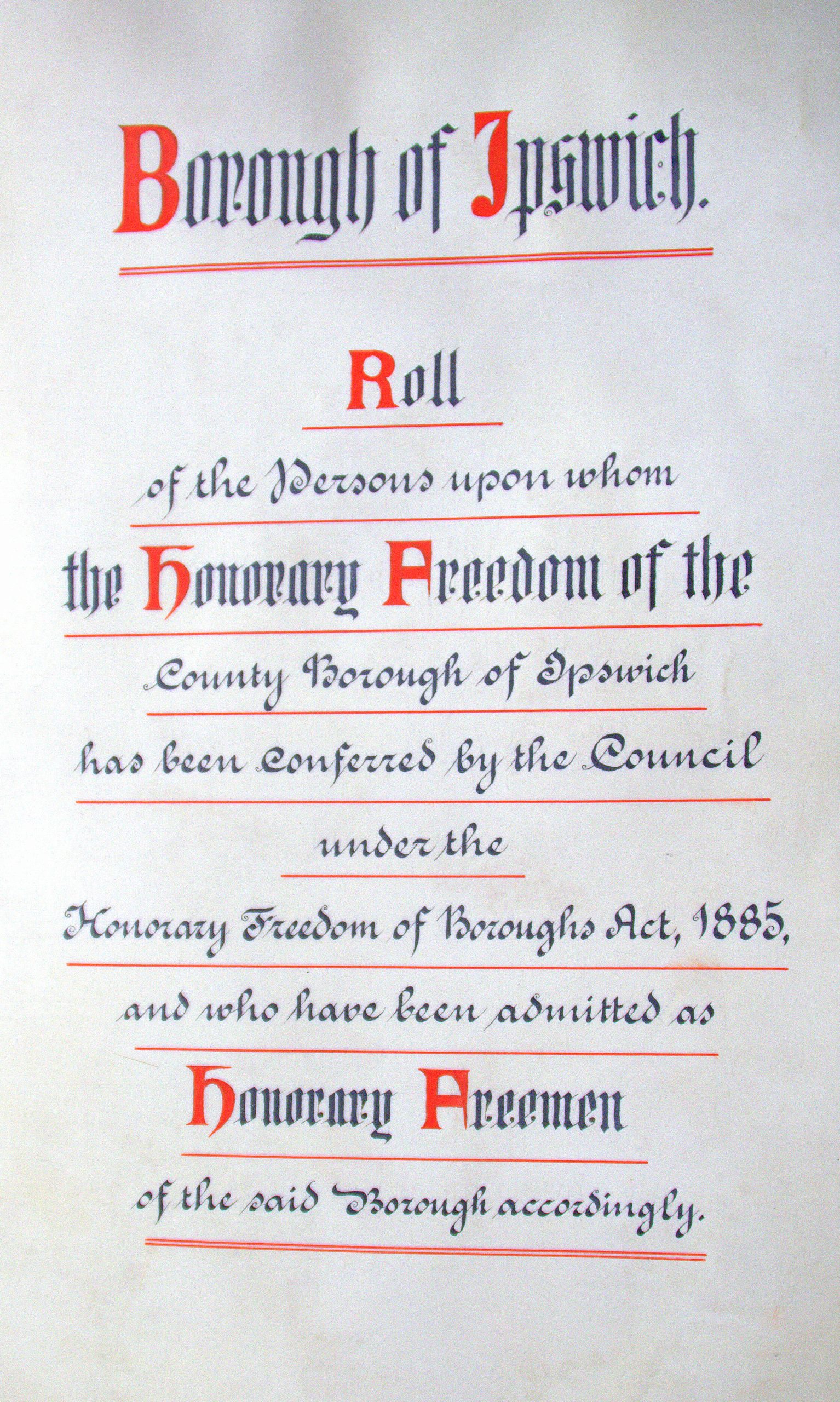
Other celebratory events included a concert arranged for him by Russian Royalty; being invited to be in a Guard of Honour for British Royalty; and the Borough of Ipswich making him a Freeman of the town, where he also went on to hold the position of Justice of the Peace.
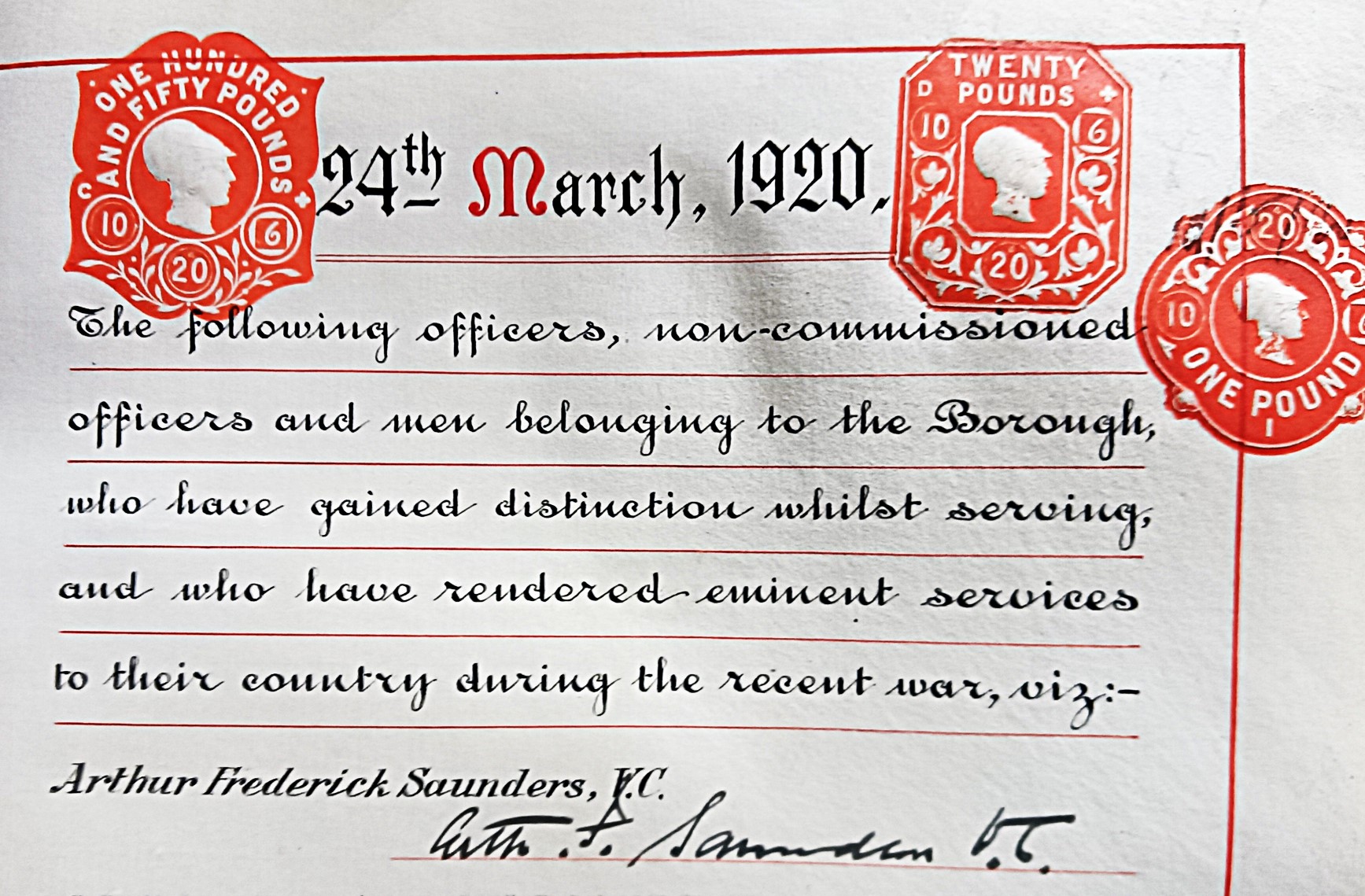
Freedom of the Borough was bestowed on Saunders as well as 56 other Ipswich WW1 service men, who obtained a DSO or DCM, being born in Ipswich. 24th March 1920.
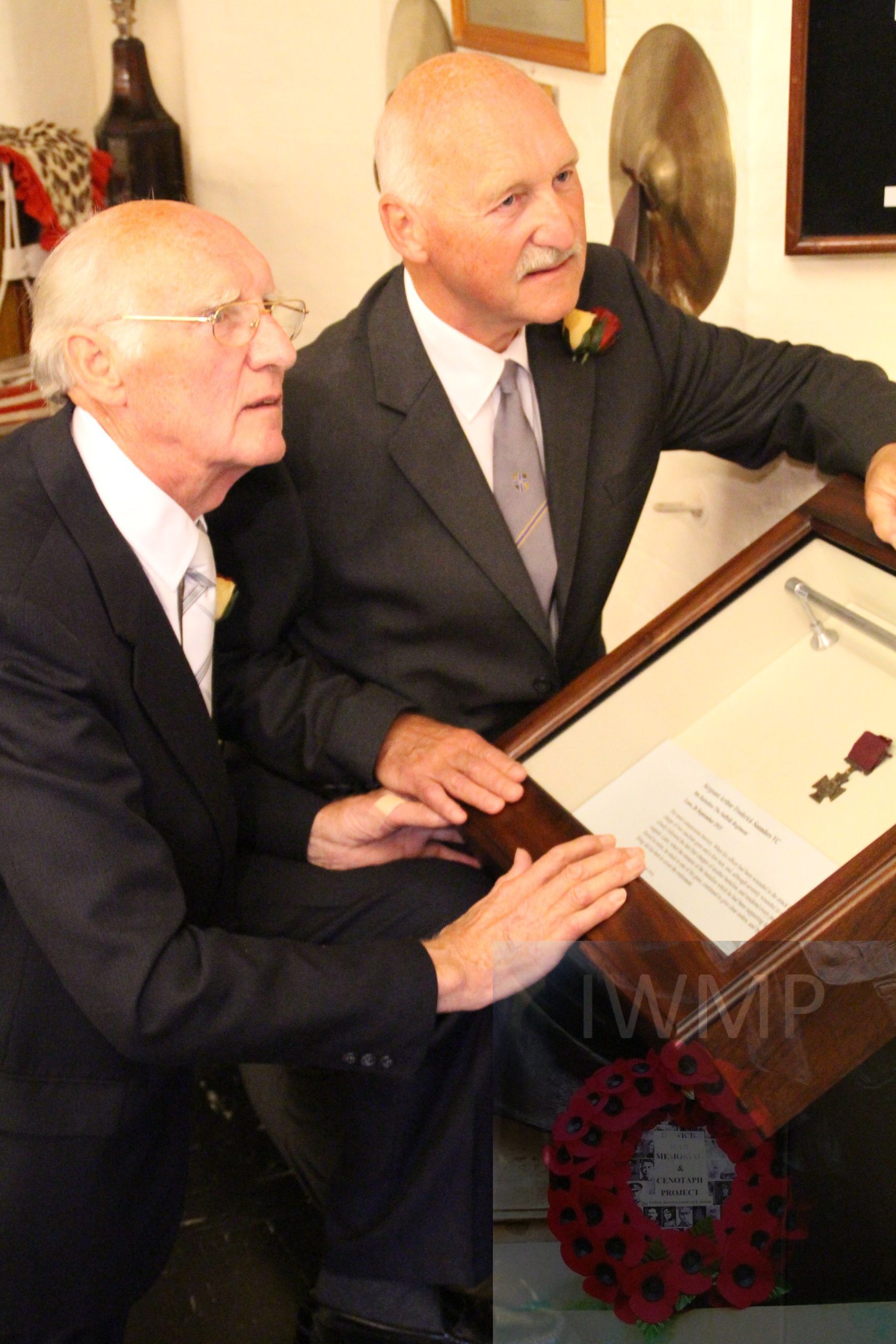
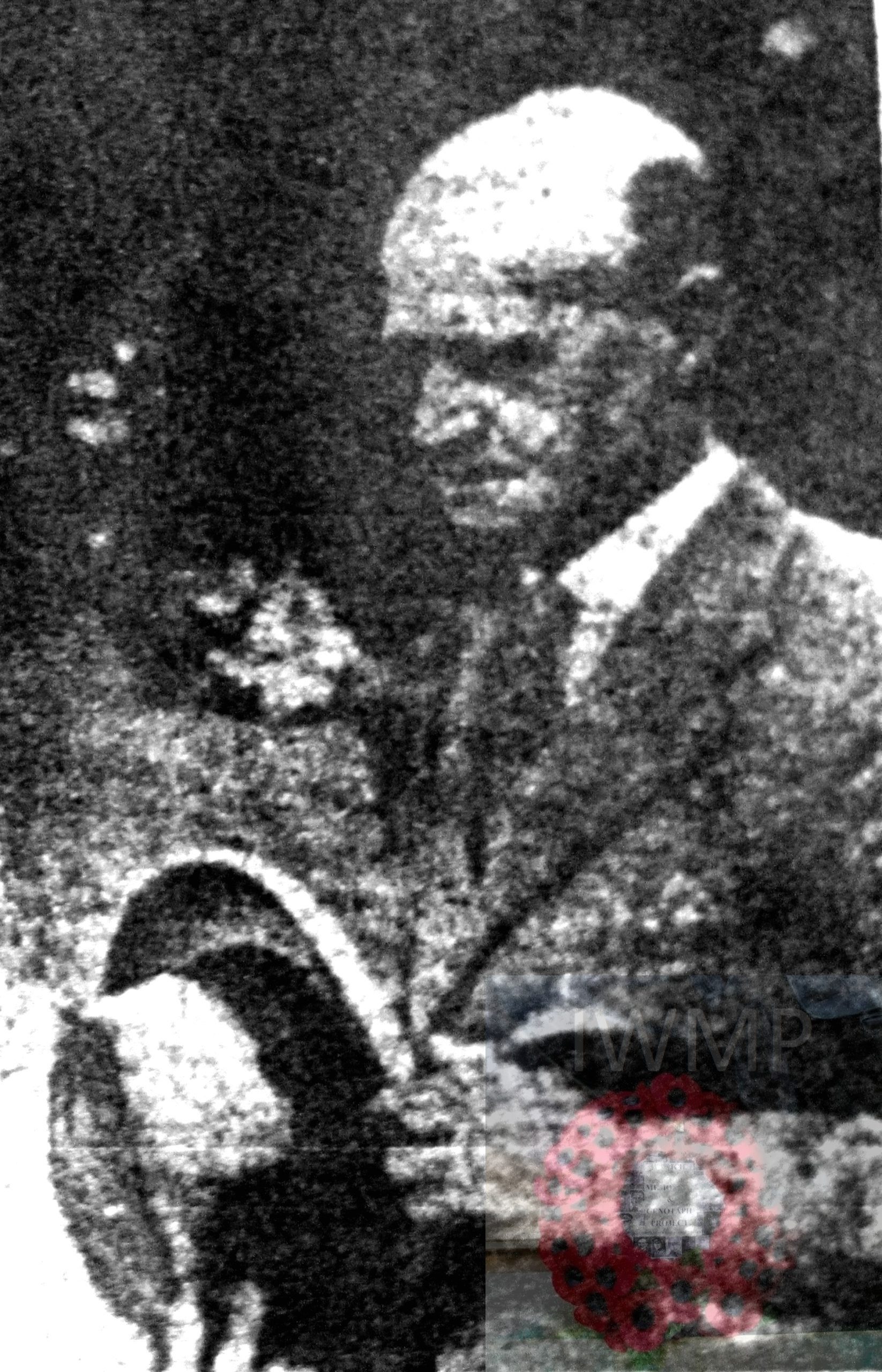 On the outbreak of World War Two, he volunteered and served with the Home Guard before passing away in July 1947. His wife, Edith, celebrated her 99th birthday by donating his V.C. medal to the Suffolk Regiment. Today it is in a museum in Bury St. Edmunds. It is noted that their son said this about his Mother, “Mum was aware that at the time of the donation, the V.C. had an estimated value of £90,000, saying to sell it would be like twisting a bayonet in Arthur’s back”.
Both Sergeant Arthur Saunders and Private Samuel Harvey were immortalised in history by having Gallagher Cigarette Collectors Cards printed in their honour. Arthur was known, at times, to have the odd drink with Sam, meeting and discussing their own personal experiences from the battle they both fought. Both soldiers were awarded the highest accolade for bravery there was to win in one of the fiercest battles in history – the only difference was the journey their lives took after the war.
Two things separated them from each other, regardless of each winning the highest accolade possible: one being their ranks, and secondly, whilst Arthur Saunders was born and bred in Ipswich, Samuel Harvey only moved to Ipswich at the age of three.
Even though both were schooled and grew up on the same streets, Uncle Sam was always looked upon as a Nottinghamshire lad.
Forty years after his death, a headstone was placed on Sam’s originally unmarked grave and celebrated by family members at a service along with representatives from the Army. School children from a local school did projects just as I had done all those years ago about Sam Harvey’s bravery and, together with the kind support and assistance of a local care home, raised enough money to plant a tree by his grave in his honour.
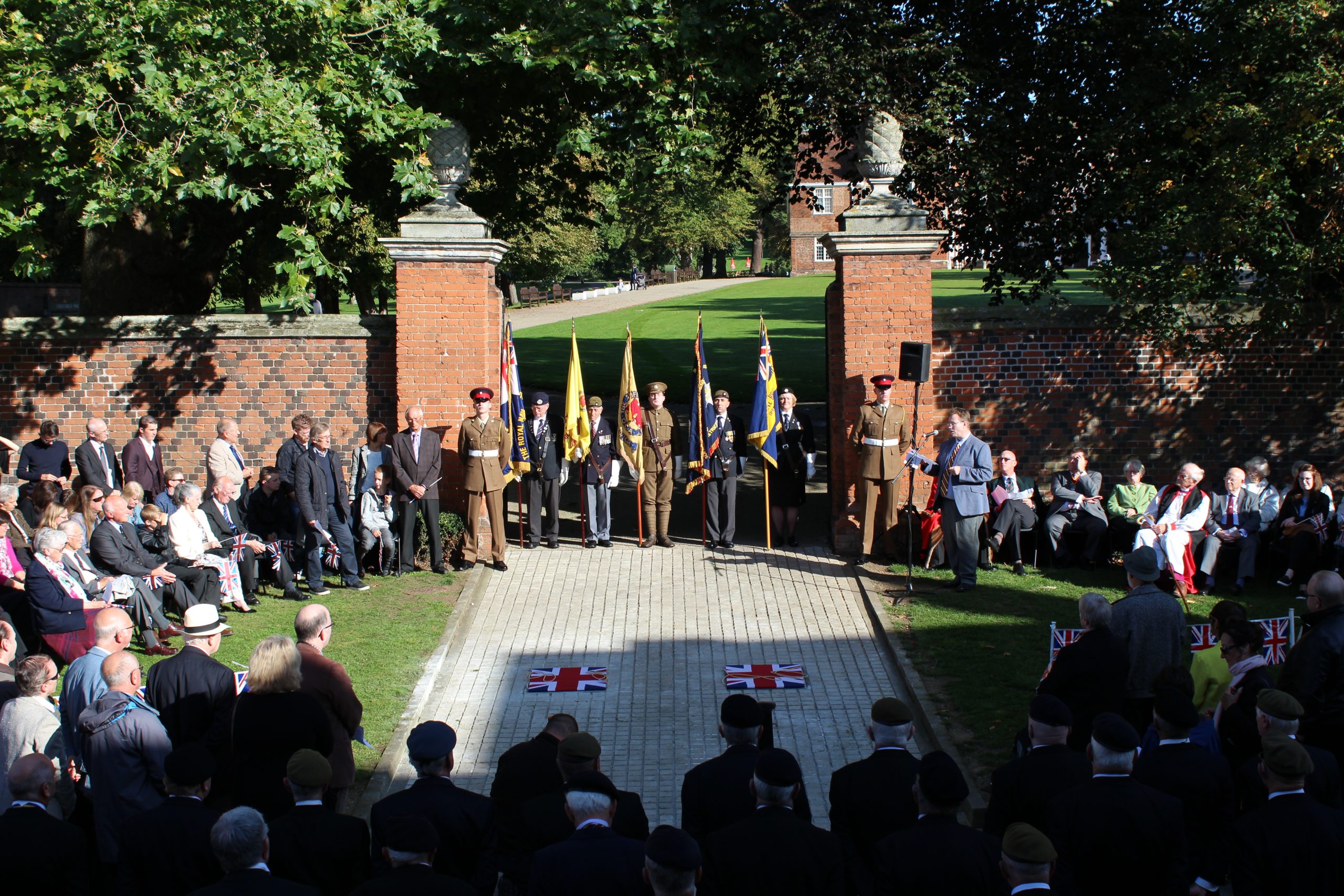
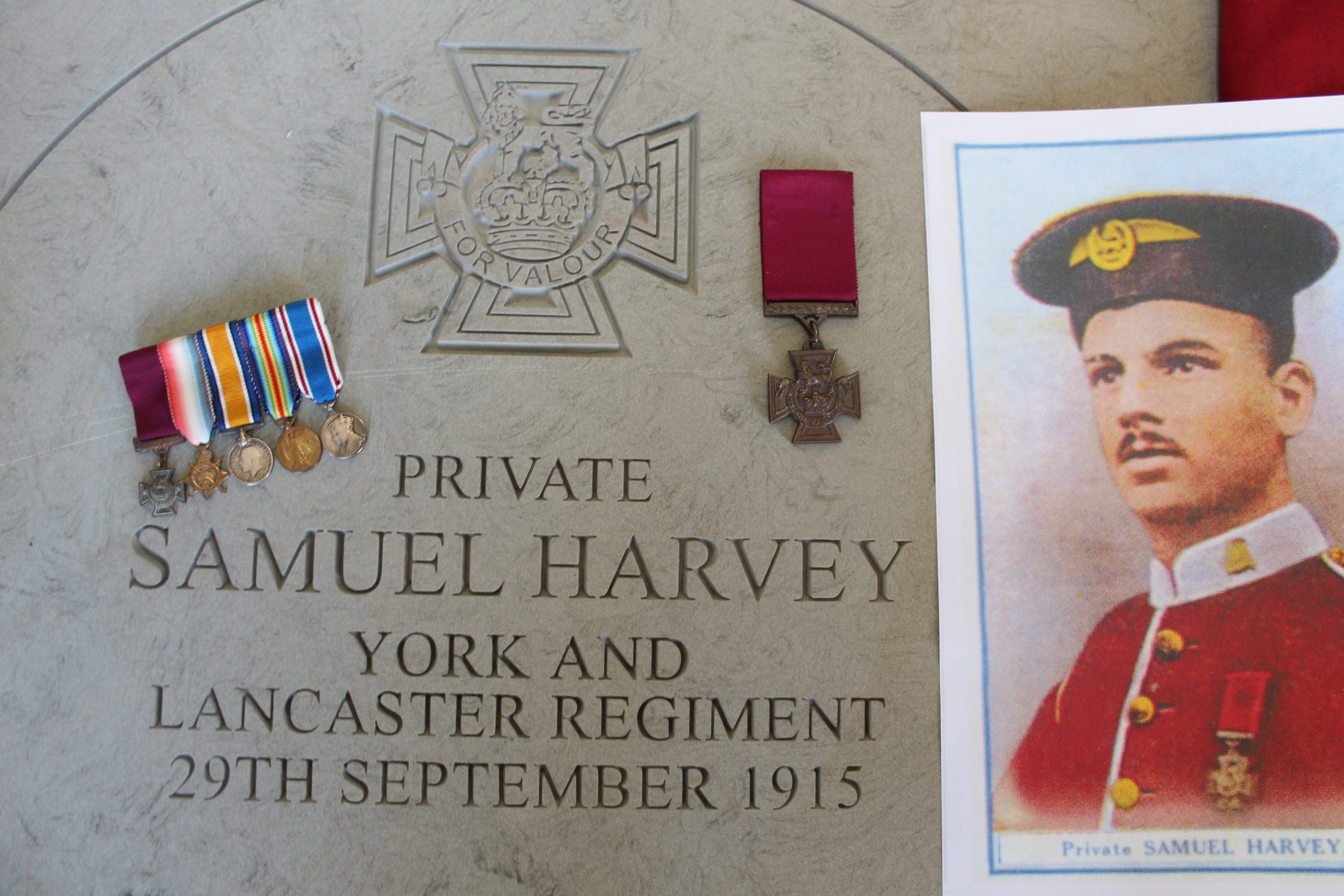
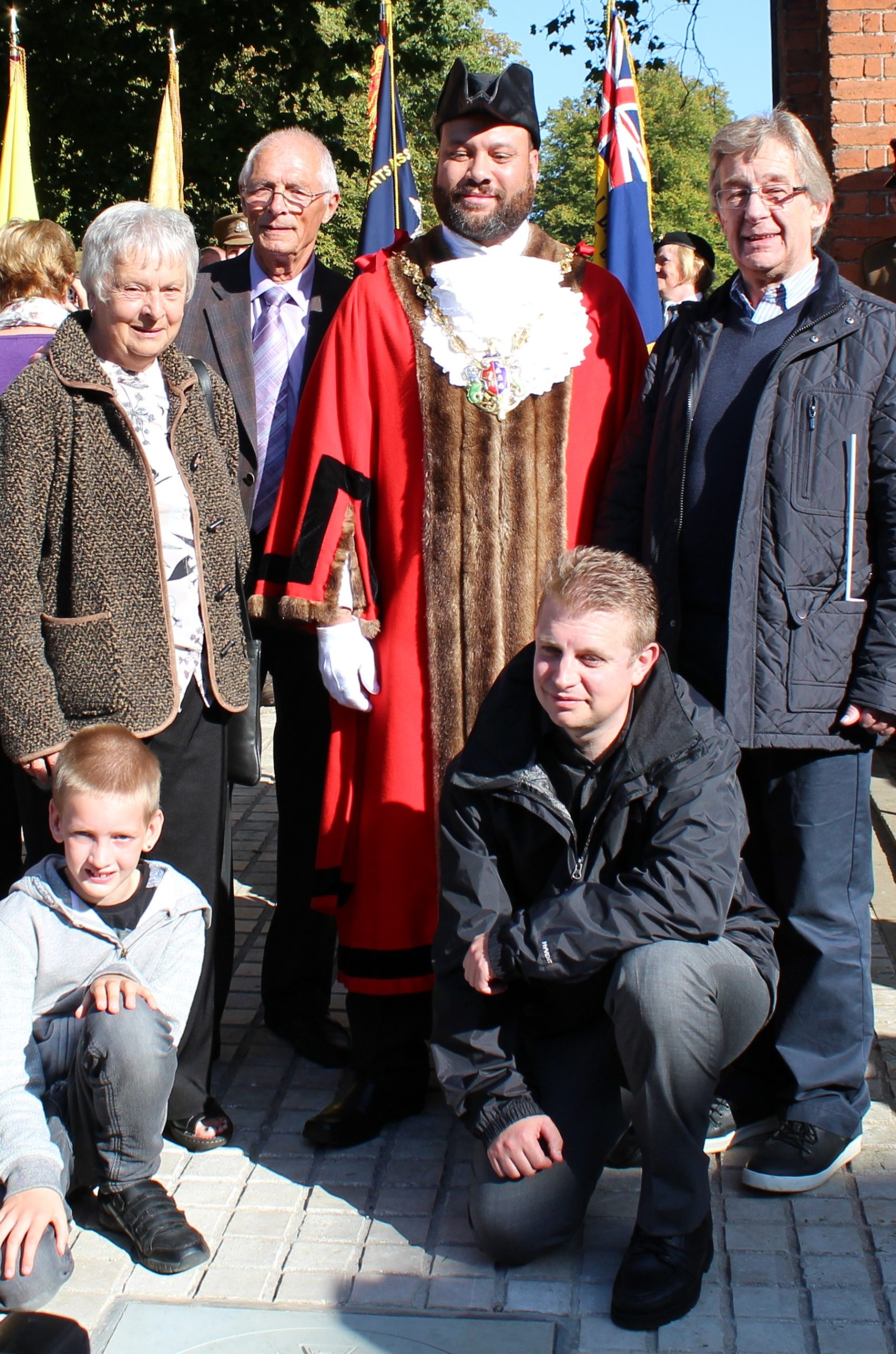
Thereafter, they both received the same recognition – concrete memorial slabs, one for Sergeant Arthur Saunders and one for Private Samuel Harvey. Both were unveiled outside the main gates at Christchurch Park in a service, thus recognising them both as from Ipswich. Inside the gates, a monument had stood for decades bearing the names of those from the town who died fighting alongside them in WW1.
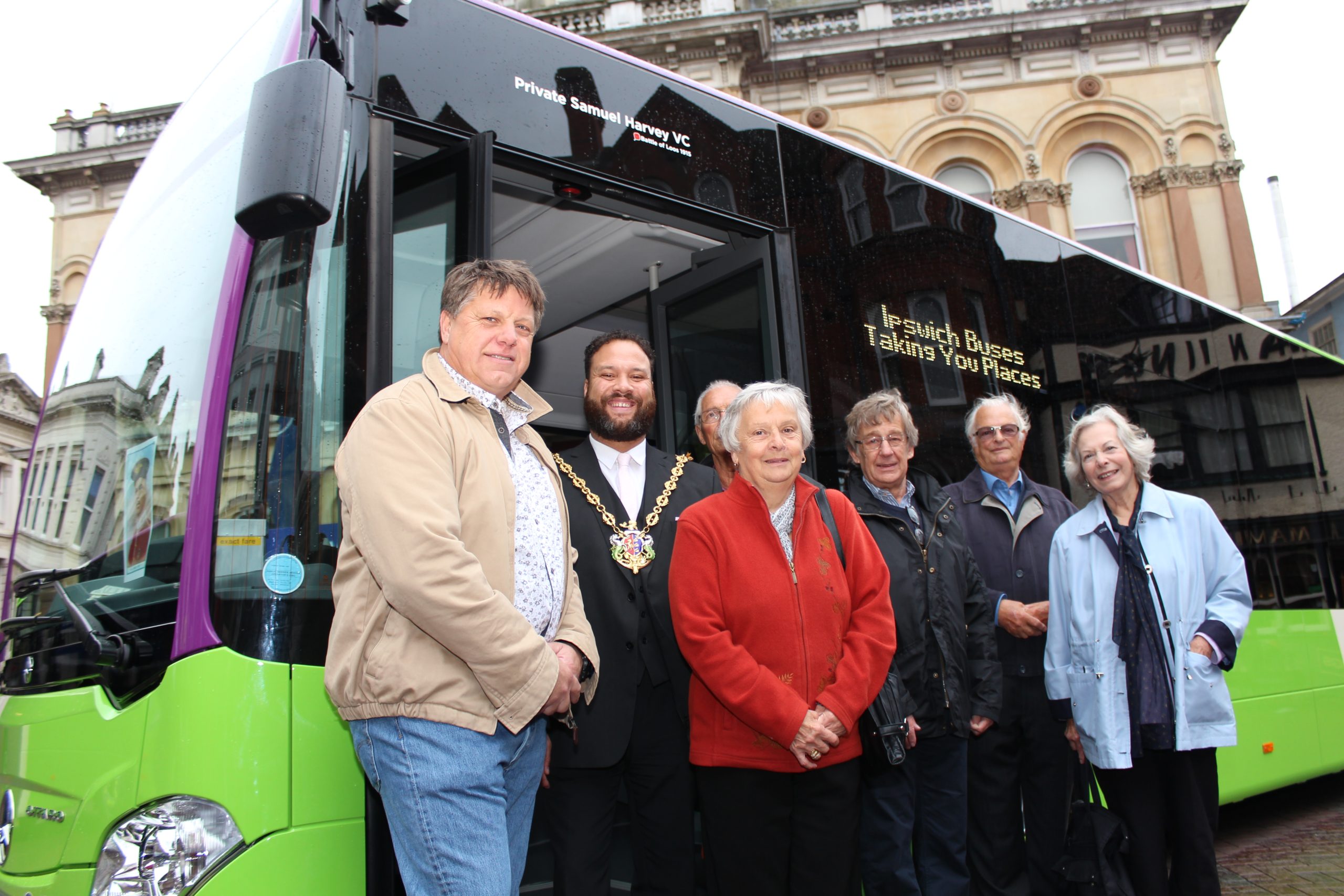 Another honour saw them both have two brand new Ipswich Borough public buses named after them. One being inscribed with Sergeant Arthur Saunders V.C. and the other Private Samuel Harvey V.C. (ironically, they were both built by the Company Mercedes from Germany – the very same country they were trying to defeat). One other accolade Sam received (without Arthur) was from the Briarbank Brewing Company in Ipswich, who brewed an ale in his honour with the label on the bottle being a replica of one of the two cigarette cards displayed in the Bar, the name of the ale being…
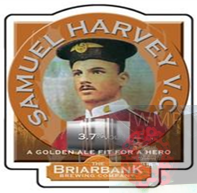
“SAMUEL HARVEY V.C.”
It would have been interesting to know which of the two accolades would have meant the most to Uncle Sam: –
The highest award possible awarded for bravery… or a bottle of ale brewed in his name?
The remaining part of this story would probably have never been written if it were not for Samuel Harvey’s love of the bottle. The reasons Sam Harvey needed to drink may have been to help him cope with the sights and sounds of battle that would have affected him and thousands of other soldiers who fought in World War I. Unlike today, there was no care or understanding available for those who were fortunate enough to escape with their lives but were left unable to function or talk about their experiences when returning home to civilian life.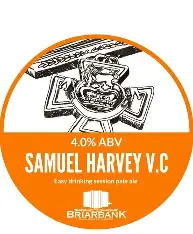
Sam Harvey may have become dependent on alcohol over the years because of this, or he may have simply just enjoyed a drink… but drink he did, and as a result of this, The Briarbank Brewing Company brewed an ale in his memory.
Had this ale not been commissioned, the Sam Harvey story may well have finished here; however, due to a request for a beer label to be forwarded, new information then came to light, sixty-two years after his death.
 The only possessions Uncle Sam was thought to have left were the set of five miniature medals that started this story. My Mother passed away believing, as did I growing up, that the medals found under his pillow the day he died, were his sole possessions….
However, a breakthrough came from an email sent to the current Briarbank brewer of the Samuel Harvey V.C. ale, by a gentleman named Jason Berryman living in Australia with a request asking if he could purchase a single beer label from a Sam Harvey VC bottle of ale, as he had items in his possession that once belonged to Sam Harvey VC and would like one to add it to his collection.
Brewer, Rob Lewis-Pyke, then kindly contacted us and through email, conversations commenced, and further revelations were received. It emerged that the gentleman was a former soldier with the New Zealand Army, and he had served in the war in Bosnia. However, it was whilst on army training in Aldershot, England, in 1994 that he obtained the items belonging to my Uncle Sam through a house clearance made in the late 1960s.
The house in question is Sam Harvey’s childhood home at 8 Vernon Street, Ipswich. The story was made that much more interesting in that the cleared items, by coincidence, were then taken back to Nottingham, the city where Sam Harvey was born, and along with items obtained from other house clearances that were thought to have no value, had spent close to 25 years gathering dust in a damp, cluttered storage shed not fit for purpose.
A friend and fellow soldier from the New Zealand Army, whilst visiting family in Nottingham, happened by chance to stop by the storage shed and enquired if there were any military paraphernalia for sale for a colleague, who was a collector of militaria, back on the army base.
After a rummage around, Sam Harvey’s belongings were retrieved, albeit in a cloud of dust and were sold on for what the seller believed to be a fair price. These were then passed on to the current custodian of these items, who, after ten years of army service, had returned home to New Zealand before emigrating to and currently residing in South Australia.
The gentleman, through further correspondence, informed me he had a number of items from the house clearance. These included various paper cuttings, one of which reported on my Great Uncle Sam as always up for a sing song after a drinking session, once again finding himself in trouble with the local constabulary in 1906 after a fracas started, resulting in a fight with a neighbour!
Another cutting in which Uncle Sam was talked about states that when he was injured when the guttering fell on him, he simply laughed it off. Other cuttings further described his life back then, including watching the traffic go by and existing on only eight Shillings a week. When asked to comment on his plight, he simply replied,
“It’s been a rum old life”…!
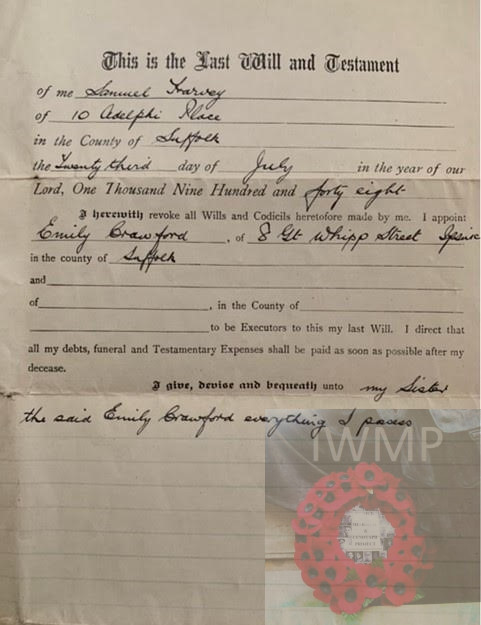
Another find from the clearance was French postcards sent by Uncle Sam to his mother while he was fighting in the First World War. His last Will was also among the lot, detailing that he was leaving his entire estate (the medals) to his Sister Emily, who was my Mother’s Aunt, and as a child, I remember visiting her home in Great Whip Street, Ipswich.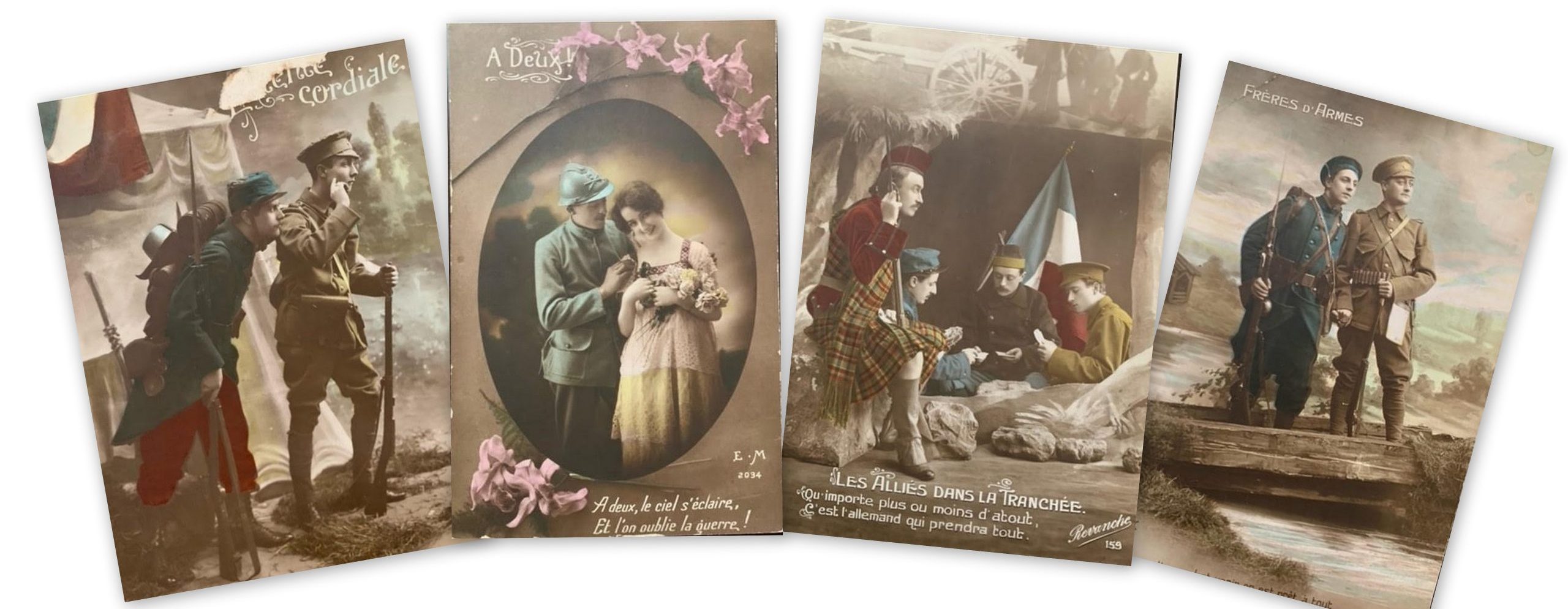
Uncle Sam wasn’t the only Harvey to have been graced by royalty, as his Sister Emily received a telegram from Queen Elizabeth II when she reached her 100th birthday.
I remember seeing this very old lady as a young child, and her being referred to by family members as stubborn and as hard as nails and living in an area which backed onto Ipswich Docks, which was infested by rats. Aunt Emily dealt with these rats by grabbing them by the scruff of their necks, hitting them over the head with her walking stick to kill them, before disposing of them in the noisy old metal dustbins with metal lids (which all houses had in their back yard in the 1960s and 1970s).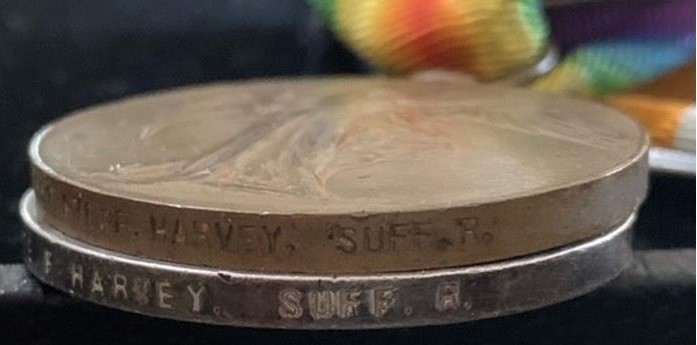
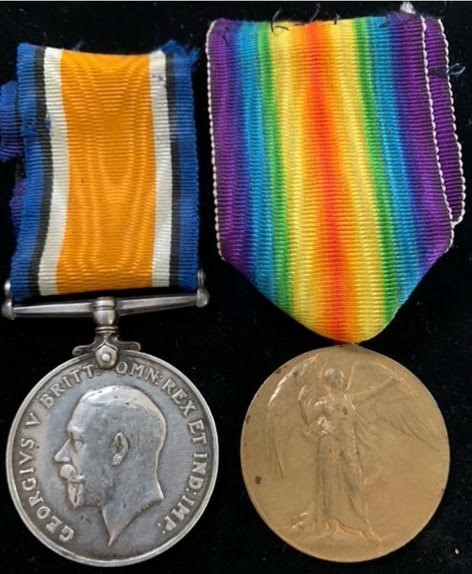 Pictures of Uncle Sam’s brother, Fredrick’s war medals, were also part of the find. Again, there was a story to go with them in true Havery fashion as he was apparently wounded in the hand whilst cleaning an Officer’s pistol, preparing for battle in the Arras War.
All this new information was exceptional, but what was still to come was both unbelievable and breathtaking….
…A photo was forwarded of what was described as eight miniature medals belonging to Samuel Harvey V.C. Every honour in the way of medals he had ever received had been kept and treasured at her Vernon Street home by Uncle Sam’s Mother and in doing so possibly saved them from being lost, sold or pawned by Sam ensuring that although having been kept in squalid and damp conditions for many years after the house clearance, went on to become a well-travelled living artifact and life size collection of every honour bestowed on Samuel Harvey VC – the only full set still in existence today.
The New Zealand war veteran said that, knowing of their importance through his own experiences of war, the right thing for him to do would be to hand them back to the family of Sam Harvey. A few weeks later, a package arrived at my home containing all of Samuel Harvey’s belongings.
My Sister and I will always be indebted to this former soldier, as even though he had invested a considerable amount of his own money in obtaining all the items back in the 90s, he insisted on sending them back to my family and the town of Ipswich at no expense to us.
Jason’s only request was that he could again taste a good old traditional Sunday roast dinner with all the trimmings, for when he found the time to make the flight from Australia to England and get to meet me and visit my Great Uncle’s grave.
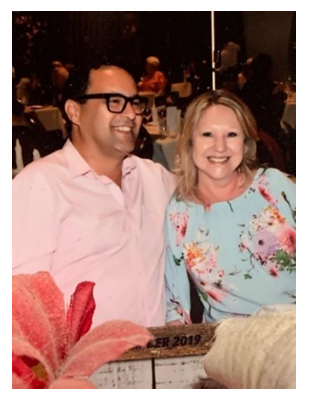
‘JASON BERRYMAN – A MAN WHO DIDN’T HAVE TO GIVE… BUT GAVE ANYWAY’
On Saturday, the 3rd August 2024, true to his word, Jason, along with his wife Angie, arrived on British soil. After meeting them at the railway station and following a short tour of the area, where the houses would have stood where Sam Harvey lived; the school still standing which he would have attended; the White Horse Hotel where he would have worked; the Town Hall steps where he slept; a visit to Wolves Wood where he lived, culminating with an official handing over of the medals whilst raising a glass of Samuel Harvey V.C. ale at the Briarbank Brewery Company where, without its existence this part of the story would not have evolved.
Abygail Fossett, a specialist writer for the local Ipswich newspaper, recorded the occasion in detail to give the people of Ipswich and beyond a chance to read about what was, for myself and Jason, a monumental occasion.
The following day, Jason, Angie and I visited Uncle Sam’s grave, where one great soldier saluted a war hero and relived the legacy that he had left.
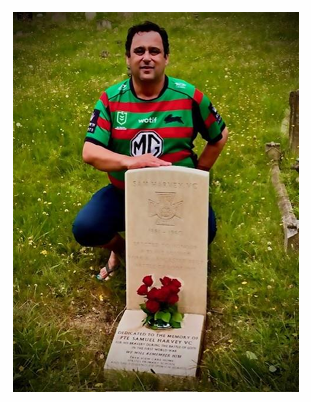
Finally, that one request that Jason had wanted throughout this whole journey was honoured, and a traditional Sunday roast dinner alongside ///////////and our wives was had, and where a friendship was forged – one that would never have happened if not for a set of war medals, but one, regardless of if we ever met again, would be cemented forever.
The last story my Mother ever told was when she only had a few days to live. Princess Anne visited her ward at the St. Elizabeth Hospice in Ipswich, where my Sister and I were at her bedside. When being introduced to the Princess, my Mother said, “My Uncle was given the Victoria Cross by one of your relations,” and with some help from my Sister, a brief account of this story was told to the Princess.
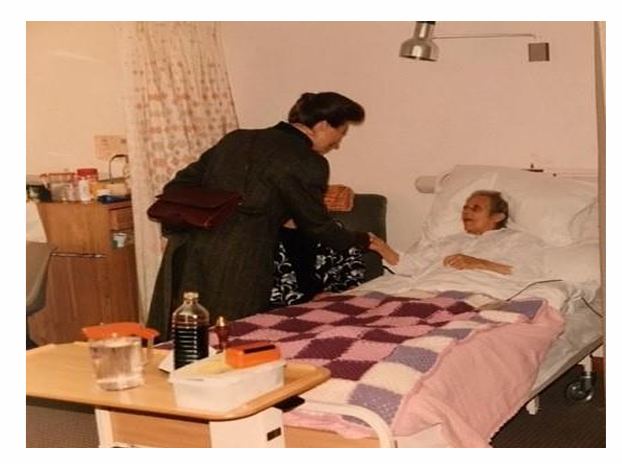
My Mother telling this story of how a hero met a King and was honoured by a Queen, whilst holding the hand of a compassionate Princess. Days later, she passed away peacefully….
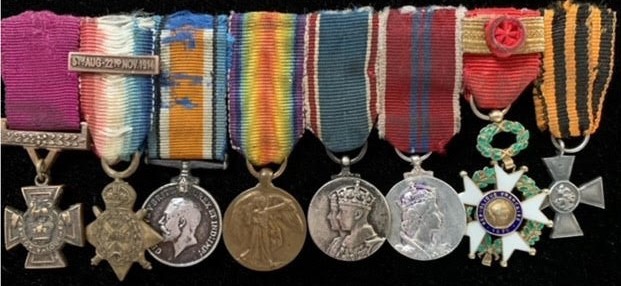
Samuel Harvey’s Honours
The Victoria Cross, The 1914-15 Star, The British War Medal (1914-1920), The Victory Medal (1914-1919), The King George VI Coronation Medal, The Queen Elizabeth II Coronation Medal (1953), The Knight Legion of Honour (5th class), Franc,e The Cross of St George (4th class), Russia
This is probably the most detailed manuscript ever written about Private Samuel Harvey… Monkey…Uncle Sam, with the intention of keeping his story alive.
This in the hope that sometime in the next 100 years (where it may be found gathering dust on a shelf or as a job lot at a car boot sale) it ends up in the hands of somebody who sees its potential and has the talent and imagination to bring it alive and immortalise it in the genre of literature, poetry, song, radio, theatre, television or film. This, in turn, leaves behind a non-erasable version of the story that will survive the test of time and be able to reach and touch the tens of thousands of people that, up until now, have reached only the few.
Lastly, it is my belief that everybody is born with a purpose. Fortunately, I’ve accomplished everything I set out to do in life, mistakenly thinking the dreams I had strived to achieve were, in fact, that purpose, until sitting down to put together this manuscript with the index finger of my right hand. I now realise my true purpose. It was simply to be that of a messenger who could pass on a story….
THE END… POSSIBLY
Leave a Reply